Contents
7 Tips to Choose the Right Kitchen Knife
Choosing the right kitchen knife can be a daunting task. With so many different types and sizes available, it can be difficult to know which one is right for your needs. To help you make the right decision, we’ve compiled a list of 7 tips to help you choose the right kitchen knife. From the size and shape to the type of steel and handle, these tips will help you find the perfect knife for your kitchen. For more information, check out this article from The Kitchen.
You can’t do without a quality knife in the kitchen. But how do you choose the right one to work with? We’ll tell you what to look for when choosing a kitchen knife. For example, you’ll learn what the blade and handle of a knife should be made of and how you can tell if a knife is optimally balanced.
The purpose of a knife
For normal home use, you can usually get by with 3-5 types of kitchen knives. At least the following types should not be missing from your equipment:

Depending on your needs, you can expand your knife collection with, for example, fish filleting knives, cheese knives or spearing and boning knives.
Blade material
When choosing a quality knife, you should be primarily interested in the blade material. This is because it affects its sharpness, weight and resistance to corrosion or dulling. Most often you will find blades made of stainless steel, carbon steel and ceramic.
Stainless steel
It is an alloy of iron and other elements such as chromium, molybdenum or nickel. These influence the overall quality of the blade and significantly increase its resistance to corrosion and wear. Stainless steel is particularly suitable for the production of utility knives and all helpers for slicing and cutting meat, as it perfectly penetrates even very rigid structures.
Chef’s tip: Stainless steel knives can be sharpened at home. A good quality sharpener or a kitchen knife sharpener will do the trick.
However, when choosing kitchen knives, beware of sheet metal substitutes that masquerade as hardened steel. You can tell by the fact that you can easily bend the blade of the knife. Keep your hands off such knives, as they will not survive the first encounter with bone.
Carbon steel
Blades made of carbon steel are formed from an iron oxide alloy. They are easy to sharpen and are sharper than stainless steel blades when sharpened. On the other hand, they dull much sooner and are also more susceptible to corrosion. If the blade is not properly maintained, unsightly stains can form on the blade, but these do not affect the quality of the work.
Ceramic steel
Ceramic blades are made of zirconium oxide and are characterized by high hardness and sharpness. They are also immune to wear and corrosion under normal use. The advantage is that they do not affect the taste of the food when slicing, and they preserve the vitamins in them.
Beware that the ceramic blade is very fragile due to its high hardness and can easily chip or break. For this reason, it is more suitable for cutting soft foods. You should also not put a ceramic knife in the dishwasher or use it on a hard surface such as a glass cutting board or ceramic plate.
Other materials that are used to make kitchen knife blades include:
- Damascus steel – the material called damascus was used for making knife blades in the Far East as early as BC. It is a layered steel that is usually composed of two or more different steels joined together. It is characterised by its high sharpness, durability and strength.
- Alloy steel – formed by adding other elements (such as chromium, molybdenum, or vanadium) to any type of steel. The resulting product usually has excellent properties, including increased corrosion resistance.
Blade length
The length of the blade is closely related to the type of kitchen knife. It usually ranges between 5-25 cm and depends entirely on what you intend to use the knife for.
- Short knives with blades from 5 to 12 cm are suitable for trimming, peeling fruits and vegetables, for cutting small foods or for greasing pastries.
- Medium-long knives with blades from 13 to 20 cm are ideal for slicing meat and large pieces of fruit and vegetables. These dimensions are typical for chef’s knives, filleting knives, slicing knives or Japanese Santoku knives.
- Pastry knives and pastry knives, which are used for cutting cake shells, have a blade length of 20-25 cm.

Blade shape
Like the length of the blade, the shape of the blade is also related to the type of kitchen knife. So always choose the shape depending on whether you are looking for a knife for slicing meat, cutting vegetables and fruit, boning or filleting.
Blade
The blade of the knife should reach from the tip to the guard – if the blade ends a little before the guard, the knife will be harder to handle. The blade should be smooth and evenly machined on both sides. As a rule, a single-edged blade is only for use in the hands of professional chefs.
In addition to the length of the blade, look at its shape. While a straight blade is good for slicing fruit, vegetables or meat, a serrated blade is ideal for cheese, frozen foods or fresh baked goods. By choosing the right type of knife, you’ll find it much easier and more accurate to cut specific ingredients.
Most knives need to be sharpened first after purchase, the exception being very high quality pieces or ceramic knives. And how do you know if a knife is sharp enough? Try cutting a soft tomato with it. If the knife cuts it without crushing the tomato, it is considered sharp.
Blade hardness
The quality of a knife is also determined by the hardness of the blade. This should range from 50 to 60 HCR, or Rockwell hardness grades. However, some modern knife steels reach hardnesses as high as 64 or 68 HCR.
Hand in hand with the hardness of the knife goes the brittleness of the blade. The harder the steel, the more brittle the blade, the harder it is to sharpen, but the longer its life. The already mentioned ceramic knives are an excellent example.
What else to look for in a blade
- The blade should properly taper from the blunt to the sharp side in a wedge shape. This ensures an easy and accurate cut without tearing the food unnecessarily. If you come across a knife whose blade is the same thickness across its entire width, it is probably a cheap imitation sheet metal knife that you are better off keeping your hands off.
- Between the blade and the handle of the knife there should be a guard, which has an important role in terms of safety. It prevents the fingers from slipping on the blade and the knuckles from striking the cutting board. If you come across a kitchen knife from a reputable brand that does not have a guard, it is probably a designer piece.
- Finally, don’t forget to check the blade-to-handle connection. Properly, the metal part of the blade should run the entire length of the handle to the end of the handle. This ensures that the blade is fully seated in the handle.
Knife handle
The handle of the knife, or sheath, significantly affects the overall comfort and safety when handling the knife. An ergonomic handle with a non-slip finish is therefore ideal, as it fits the hand perfectly and prevents it from slipping on the blade.
Chef’s tip: The handle should be smooth, free of bumps and unevenness. There must be no loose spots or joints where bacteria can build up.
Knife handle material
- Plastic handle – plastic is sprayed onto the handle (sprayed plastic) or fixed with rivets (solid plastic). While sprayed plastic is more susceptible to damage, solid plastic is easy to maintain and does not slip even when wet. On the other hand, it can look rather cheap.
- Wooden handle – wood is very aesthetic and pleasant to the hand, but requires careful maintenance. You need to keep it dry and wipe it immediately after washing. It also needs beeswax treatment from time to time to maintain its properties. Never put a knife with a wooden handle in the dishwasher.
- Metal handle – it is very strong, durable and has a long life. However, working with a metal handle requires practice as it slips in wet or oily hands.
Knife weight
The weight of kitchen knives varies according to the size and type of material. While small knives weigh only a few tens of grams, massive meat cleavers can weigh more than 1 kg. Generally, with a heavier knife, you don’t have to put as much pressure on the blade when slicing. This makes food preparation easier and safer, so you’ll be serving food that’s just the way you want it on the dinner table.
Still, the knife must be optimally balanced, which means that the weight of the blade and the handle are equal. You can find out with a simple test. Place the part of the knife that is between the blade and the handle on your finger. The knife must remain in a balanced position, i.e. neither the blade nor the handle must drop. Only with a balanced knife will you work well without unnecessary effort.
Certified knife manufacturers
Don’t be tempted by cheap imitations and invest in quality knives from reputable manufacturers. Some of the best known include German Wüsthof knives, Swiss Victorinox knives and Portuguese IVO knives. These knives require a larger investment, but with proper care, handling and maintenance, they can last you for years.
What is the best kitchen knife?
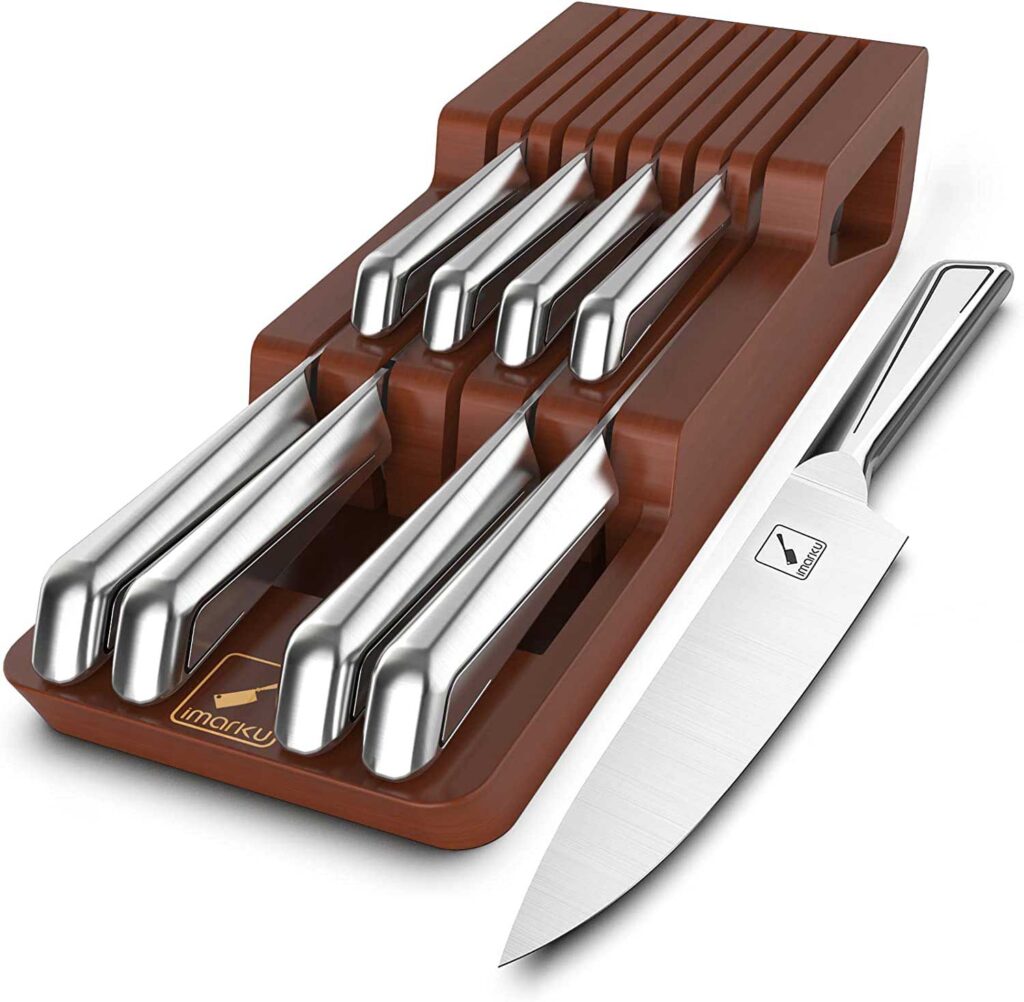
The best kitchen knife for you will depend on your needs and preferences. A good quality chef’s knife is an essential tool for any kitchen. Consider factors such as the size and shape of the blade, the type of steel used, the handle material, and the overall weight and balance of the knife when selecting a knife.
What are the different types of kitchen knives?
The most common types of kitchen knives are the chef’s knife, the paring knife, the serrated knife, the utility knife, the Santoku knife, the slicing knife, and the boning knife. Each knife is designed for a specific purpose, such as chopping, slicing, dicing, and filleting.
How do I sharpen my kitchen knife?
Sharpening a kitchen knife requires skill and practice. It is best to use a sharpening stone, honing rod, or electric sharpener to maintain the sharpness of the blade.
How do I choose the right kitchen knife?
When choosing a kitchen knife, consider factors such as the size and shape of the blade, the type of steel used, the handle material, and the overall weight and balance of the knife.
7 Tips on How to Choose the Right Kitchen Knife
- Consider the Size of the Knife
- Evaluate the Weight and Balance
- Understand the Different Types of Knives
- Examine the Handle
- Check the Quality of the Steel
- Look for a Quality Brand
- Choose the Right Price Point
Ready to upgrade your kitchen knife collection? Follow these 7 tips to make sure you’re choosing the right knife for your needs. From blade shape to handle material, there is a perfect kitchen knife out there for you. Don’t wait any longer – take action and find the perfect kitchen knife for your needs today!