



Contents
Flour and Leavening Agents: An Exploration
When it comes to baking, flour and leavening agents are essential ingredients for achieving the perfect texture and rise in baked goods. Flour provides the structure and foundation for baked goods, while leavening agents are responsible for creating the lift and lightness in the final product.
Leavening agents can come in the form of baking powder, yeast, or even natural ingredients like sourdough starter or beaten egg whites. Each leavening agent interacts with the flour in a different way, and understanding these interactions is crucial for achieving the desired outcome in your baking.
Baking powder, for example, reacts with moisture and heat to create carbon dioxide gas, which causes the dough or batter to rise. Yeast, on the other hand, feeds on the sugars in the flour and produces carbon dioxide gas through fermentation. Both of these methods ultimately result in a light and fluffy texture in the final baked good.
Knowing how to properly use and combine these ingredients is key to achieving the perfect texture and rise in your baked goods. Whether you’re making bread, cake, or cookies, understanding the science behind flour and leavening agents is essential for creating the perfect finished product.
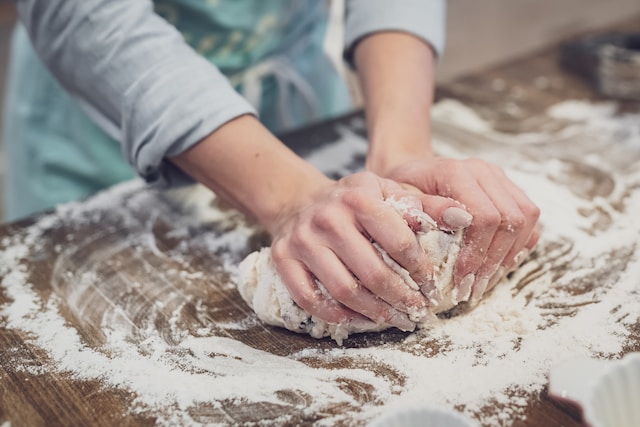
Understanding Flour and Leavening Agents
Introduction
Baking is an art form that involves balancing different ingredients to create the perfect texture and flavor in baked goods. Flour and leavening agents such as baking powder and yeast play a crucial role in achieving this balance. In this blog post, we will explore how flour interacts with leavening agents and how to achieve the desired texture and rise in baked goods.
The Role of Flour in Baked Goods
Flour is the backbone of any baked good. It provides structure, texture, and flavor to bread, cakes, and pastries. The type of flour used affects the final product’s texture and flavor. For example, bread flour contains more gluten than all-purpose flour and produces chewier bread. Cake flour is finer and produces a tender crumb in cakes.
The Function of Leavening Agents
Leavening agents create air pockets in the dough or batter, allowing the baked good to rise. Baking powder is a chemical leavening agent that contains baking soda and an acid. When combined with a liquid, it releases carbon dioxide gas, causing the dough or batter to rise. Yeast is a biological leavening agent that feeds on sugar and releases carbon dioxide gas as a byproduct.
Interactions between Flour and Leavening Agents
Flour and leavening agents must work together to create the perfect baked good. The amount and type of leavening agent used will depend on the type of flour and the desired texture. All-purpose flour and baking powder are often used together to create light, fluffy baked goods such as biscuits and pancakes. Bread flour and yeast are used to create chewy, dense bread. Too little leavening agent will result in a dense, heavy product, while too much will cause the baked good to collapse or have a chemical taste.
Tips for Achieving the Desired Texture and Rise
Here are some tips for achieving the perfect texture and rise in your baked goods:
- Use the right type of flour for the desired texture
- Measure your ingredients accurately
- Do not overmix the batter or dough
- Preheat the oven to the correct temperature
- Do not open the oven door during baking
- Adjust the amount of leavening agent as needed
Conclusion
Understanding how flour interacts with leavening agents is essential to achieving the perfect texture and rise in your baked goods. By using the right type and amount of flour and leavening agent and following the tips above, you can create delicious, perfectly textured baked goods every time.

FAQs: Flour and Leavening Agents
Q: What are leavening agents?
Leavening agents are ingredients that help to make baked goods rise. They do this by creating gas bubbles that cause the dough or batter to expand.
Q: What types of leavening agents are there?
The two main types of leavening agents are chemical and biological. Chemical leavening agents include baking powder and baking soda, which react with acidic ingredients to create carbon dioxide gas. Biological leavening agents include yeast, which feeds on sugars in the dough and releases carbon dioxide gas.
Q: How does flour interact with leavening agents?
Flour plays a key role in determining the texture and rise of baked goods. The amount and type of flour used can affect the performance of leavening agents. For example, bread flour has a higher protein content than all-purpose flour, which helps to create a stronger gluten structure. This can result in a better rise and a chewier texture.
Q: How can I achieve the desired texture and rise in my baked goods?
The amount and type of leavening agent used will depend on the recipe and the desired outcome. It’s important to follow the recipe carefully and measure ingredients accurately. If you’re experimenting with a recipe or need to adjust the leavening, start by making small changes and testing the results. Keep in mind that different types of flour, humidity levels, and elevation can all affect how doughs and batters rise and bake.

Flour and Leavening Agents
Understanding the Interaction for Perfectly Baked Goods
When it comes to baking, flour is a crucial ingredient that forms the backbone of most recipes. However, to achieve the desired texture and rise in baked goods, it is essential to pair flour with the right leavening agents. Leavening agents, such as baking powder and yeast, play a critical role in making your baked goods fluffy and light.
It is essential to understand the interaction between flour and leavening agents to achieve perfectly baked goods every time. Flour provides the structure, while leavening agents add volume. However, too much leavening agent can cause your baked goods to rise too quickly, leading to an uneven texture or collapse.
Baking powder is a popular leavening agent that comes in different varieties. It is made by mixing an acid (usually cream of tartar) with baking soda. When heated, the acid reacts with the baking soda to produce carbon dioxide gas, which causes the batter to rise.
Yeast is another common leavening agent that is used in bread-making. Unlike baking powder, yeast needs time to work its magic. Yeast feeds on sugar and produces carbon dioxide gas, which makes the dough rise. You need to give the dough enough time to proof to ensure that the yeast has enough time to activate.
To achieve the desired texture and rise in your baked goods, it’s important to use the correct amount of leavening agent. The amount you need will depend on the type of flour you are using and the recipe you are following. It’s essential to read the recipe carefully and measure out the leavening agent accurately.
Overall, achieving perfectly baked goods requires understanding the interaction between flour and leavening agents. With the correct pairing and measurements, you can create delicious baked goods every time.
If you want to learn more about flour and leavening agents, check out this page on Wikipedia. You can also find more baking tips and techniques on Special Magic Kitchen.
Flour and Leavening Agents: An Exploration
- Flour interacts with leavening agents like baking powder and yeast to create the desired texture and rise in baked goods.
- Baking powder contains both an acid and a base that react to create carbon dioxide gas, causing dough or batter to rise.
- Yeast is a single-celled organism that feeds on simple sugars and produces carbon dioxide gas as a by-product, causing dough to rise.
- The amount and type of leavening agent used, as well as the type of flour, can affect the texture and rise of baked goods.
- Too much leavening agent can cause over-rising and collapsing, while too little can result in a dense texture.
- Flour with a higher protein content, such as bread flour, can make for a more chewy and structured texture, while lower protein flours, such as cake flour, can produce a more tender texture.





